What Does a Fiddle Leaf Fig Really Need to Thrive?
Everything Ficus lyrata needs, from light and water to leaf fixes.
Fiddle Leaf Fig (Ficus lyrata) care succeeds when you match its native tropical conditions: bright filtered light, consistent moisture without soggy soil, and warm, humid air. This complete guide answers every common question about the plant, from how big it grows indoors and how fast, to why leaves turn yellow, brown, or drop, and exactly what to do at each stage. It covers potting, feeding, pruning, propagation, pests, diseases, and seasonal care so you can diagnose a struggling tree and keep a healthy one thriving for years.
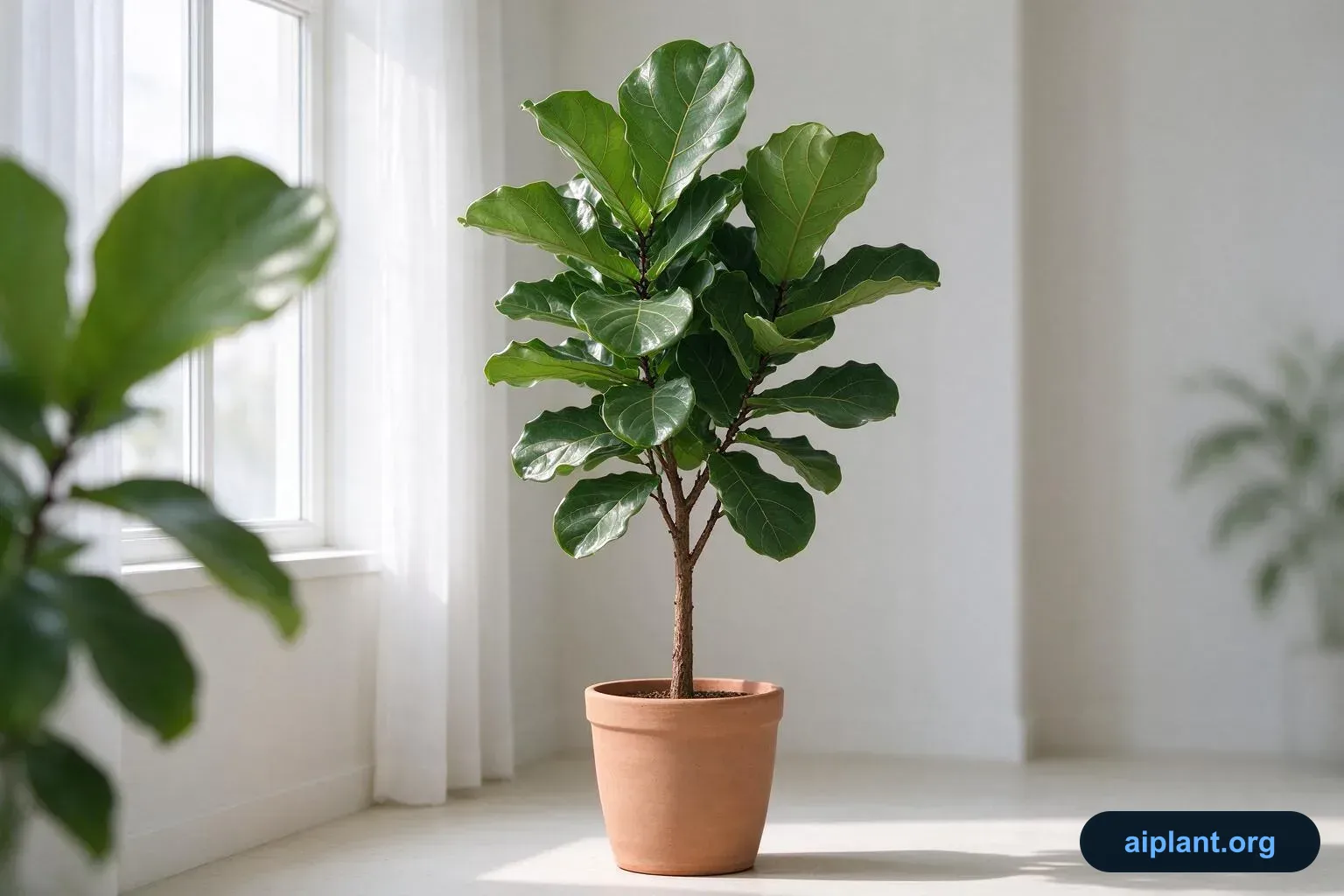
Fiddle Leaf Fig Care at a Glance
- Give Fiddle Leaf Fig bright, filtered light for 6–8 hours daily; direct summer sun can scorch leaves, while low light stalls growth.
- Water when the top 5–8 cm (2–3 in) of soil is dry, usually every 7–10 days in summer and 10–14 days in winter, and never let the pot sit in water.
- Use a well-draining mix of potting soil, perlite, and bark in a pot with drainage holes, and repot every 2–3 years in spring.
- Keep temperatures between 18–27 °C (65–80 °F), humidity at 40–60%, and fertilize monthly in spring and summer.
- Fix leaf problems by checking watering first: yellow leaves usually mean overwatering, brown edges mean dry air or inconsistent watering, and drooping means thirst or root stress.
What Is a Fiddle Leaf Fig and How Does It Grow?
Fiddle Leaf Fig (Ficus lyrata) is a tropical evergreen tree from West African lowland rainforests, grown indoors for its large, violin-shaped leaves. In the wild it can reach 12–15 m (40–50 ft), but indoors it usually stays 1.5–3 m (5–10 ft) with a single trunk and a crown of leathery leaves 30–45 cm (12–18 in) long. It is not a low-maintenance beginner plant, but it is predictable once its light and watering needs are met.
Leaves and growth habit: The leaves are broad at the tip and narrow at the base, with prominent pale veins and a slightly wavy edge. New leaves emerge from the growing tip in a sheath and unfurl over 1–2 weeks. Indoors, growth is upright and tree-like; without pruning it tends to stay single-stemmed.
Indoor size and growth rate: A young nursery plant grows 30–60 cm (12–24 in) per year in good light, slowing to 10–20 cm (4–8 in) in lower light or winter. A healthy indoor Fiddle Leaf Fig can reach 1.8–2.4 m (6–8 ft) in 5–8 years, and with patience and a large pot, 3 m (10 ft) or more. Lifespan indoors is long—decades—if roots are not left waterlogged.
Outdoor growth and climate: Fiddle Leaf Fig can grow outdoors year-round only in tropical and subtropical climates, roughly USDA zones 10–12, where temperatures stay above 10 °C (50 °F). In those climates it becomes a large landscape tree and may produce small, inconspicuous fig fruits. In cooler zones it must be grown in a pot and brought indoors before nights fall below 10 °C (50 °F).
Flowering: Fiddle Leaf Fig does not flower or fruit indoors. The tiny flowers are enclosed inside the fig and pollinated by a specific wasp that is absent outside its native range, so indoor plants never produce visible blooms. Lack of flowers is normal, not a care failure.
Look-alikes: Fiddle Leaf Fig is sometimes confused with Ficus elastica (Rubber Plant), which has oval, glossy leaves, and with Ficus benghalensis (Ficus Audrey), which has fuzzy, matte leaves and a lighter trunk. Fiddle Leaf Fig leaves are distinctly violin-shaped with a narrower base and wavy margin.
Fiddle Leaf Fig Varieties Compared
Fiddle Leaf Fig Light, Temperature, and Humidity Needs
Fiddle Leaf Fig needs bright, filtered light for 6–8 hours a day, warm temperatures of 18–27 °C (65–80 °F), and moderate humidity of 40–60%. These three factors explain most growth and leaf-quality differences between thriving and struggling plants.
Best indoor light: Place the plant within 1–2 m (3–6 ft) of a south- or east-facing window, or directly in an east window. A sheer curtain protects leaves from harsh midday summer sun. In the Northern Hemisphere, a south window gives the strongest light in winter; in summer, move the plant 30–60 cm (1–2 ft) back from the glass to avoid scorch.
Can Fiddle Leaf Fig survive in low light?: It can survive for months in low light but will not thrive. Expect slow or no new growth, smaller leaves, leggy stems, and increased leaf drop. If low light is unavoidable, supplement with a full-spectrum LED grow light for 10–12 hours a day, positioned 30–45 cm (12–18 in) above the canopy.
Signs of too much direct sun: Brown, bleached patches on leaves facing the window, especially in summer afternoons. Move the plant back or diffuse the light; damaged leaves will not heal but new growth will be normal.
Temperature range: Keep Fiddle Leaf Fig between 18–27 °C (65–80 °F). It tolerates brief dips to 10 °C (50 °F) but suffers chilling below that. Avoid cold drafts from doors, windows, and air conditioners, and keep leaves away from radiators and heat vents, which dry them.
Humidity: Aim for 40–60% relative humidity. In dry indoor air, especially in winter, use a humidifier, group plants together, or set the pot on a pebble tray with water below the pot base. Mist is not a reliable fix and can encourage fungal spots if leaves stay wet.
Air movement: Good air circulation reduces fungal disease and spider mites. A ceiling fan on low or a nearby open doorway helps, but avoid blasting the plant with direct air.
Fiddle Leaf Fig Care Card
- Light
- Bright filtered, 6–8 hours daily
- Water
- When top 5–8 cm (2–3 in) is dry
- Temperature
- 18–27 °C (65–80 °F)
- Humidity
- 40–60% relative humidity
- Soil
- Well-draining mix with perlite and bark
- Fertilizer
- Monthly in spring and summer
- Safe for Cats & Dogs?
- Check the ASPCA toxic plant list
How Often to Water Fiddle Leaf Fig and How to Tell
Water Fiddle Leaf Fig when the top 5–8 cm (2–3 in) of soil feels dry, which is usually every 7–10 days in summer and every 10–14 days in winter indoors. The exact interval depends on pot size, light, and room temperature, so test the soil rather than following a calendar.
The finger test: Push a finger into the soil up to the second knuckle. If it feels dry at that depth, water thoroughly until water runs from the drainage holes. If it feels cool and moist, wait 2–3 days and test again.
The weight test: Lift the pot after watering and again a week later. A noticeably lighter pot means the soil has dried enough to water. This is especially useful for large pots where the finger test is hard.
How to water correctly: Water slowly and evenly across the surface, let the excess drain completely, and empty the saucer within 30 minutes. Never let the pot stand in water; roots need air between waterings. In winter, use room-temperature water to avoid cold shock.
Signs of underwatering: Leaves droop, feel limp, and develop dry, crispy edges; new leaves may be small. Soil pulls away from the pot sides. Water thoroughly and check again after 24 hours; recovery is usually visible within a day.
Signs of overwatering: Yellowing lower leaves, soft or mushy stems, soil that stays wet for more than 10 days, and a sour smell from the pot. Stop watering, let the soil dry, and check drainage. If several leaves yellow at once and the soil is soggy, suspect root rot and inspect the roots.
Seasonal adjustment: In summer, plants in bright light may need water every 5–7 days. In winter, growth slows and water use drops; check soil every 10–14 days and water less. Never water on a fixed schedule without checking the soil first.
Fiddle Leaf Fig Watering Signals
Fiddle Leaf Fig Soil, Pot Size, and Repotting
Fiddle Leaf Fig needs a well-draining, airy soil mix and a pot only 2–5 cm (1–2 in) wider than the root ball. Heavy, soggy soil is the most common cause of root rot and yellow leaves in this plant.
Best soil mix: Combine 50% quality potting soil, 30% perlite, and 20% orchid bark or coco chips. This gives moisture retention with fast drainage. Avoid pure garden soil, dense compost, and self-watering pots that keep the root zone constantly wet.
Pot size: Choose a pot with drainage holes and a diameter 2–5 cm (1–2 in) larger than the current root ball. A pot that is too large holds excess water and raises rot risk. A 1.5–2 m (5–6 ft) plant typically needs a 35–45 cm (14–18 in) pot.
When to repot: Repot every 2–3 years in spring, or when roots circle the pot, grow out of drainage holes, or the plant dries out within 2–3 days of watering. Avoid repotting in winter or immediately after moving the plant, as stress compounds.
How to repot a Fiddle Leaf Fig
- Prepare one day ahead: Water lightly the day before so roots are pliable, and prepare a pot 2–5 cm (1–2 in) wider with fresh mix.
- Remove the root ball: Lay the pot on its side, support the trunk, and slide the plant out. Never pull by the stem.
- Inspect and loosen roots: Gently tease apart circling roots and trim any brown, mushy roots with clean scissors. Healthy roots are firm and pale.
- Set the plant at the same depth: Place the root ball so the top sits 2–3 cm (1 in) below the rim, then fill around it with the new mix, firming lightly.
- Water and settle: Water thoroughly until it drains, top up settled soil, and keep the plant in bright indirect light for 2–3 weeks, with no fertilizer.
After repotting: Expect some leaf drop for 1–2 weeks; this is normal transplant stress. Do not fertilize for 4–6 weeks, and water only when the top 5–8 cm (2–3 in) dries.
Fiddle Leaf Fig Pot Size by Plant Height
Feeding, Pruning, and Propagating Fiddle Leaf Fig
Fertilize Fiddle Leaf Fig monthly in spring and summer with a balanced liquid fertilizer at half strength, prune in early spring to shape the plant, and propagate from stem cuttings in late spring or summer. Each of these tasks is straightforward but timing matters.
How often to fertilize: Feed once a month from March to September with a 10-10-10 or 3-1-2 liquid fertilizer diluted to half the label rate. Stop in late autumn and winter, when growth slows. Overfertilizing causes salt buildup, shown by white crust on the soil and brown leaf tips; flush the pot with water every 3–4 months.
Pruning for shape and height: Prune in early spring before new growth starts. Remove dead or damaged leaves anytime. To control height, cut the main stem 10–15 cm (4–6 in) above a leaf node; the plant will branch from below the cut. Make clean cuts with sterilized pruners and wipe the blade between cuts.
How to prune a Fiddle Leaf Fig
- Choose the cut point: Pick a node 30–60 cm (12–24 in) below the desired final height, leaving at least 3–4 leaves below the cut.
- Cut at a slight angle: Use sharp, clean pruners and cut 1–2 cm (0.5 in) above the node. A slanted cut sheds water and reduces rot.
- Remove lower leaves if leggy: Take off the lowest 2–4 leaves to encourage branching lower on the trunk.
- Seal and wait: Sap will flow briefly; wipe it away. New shoots usually appear at the cut node within 3–6 weeks in good light.
How to propagate Fiddle Leaf Fig: Take stem cuttings in late spring or summer when the plant is actively growing.
- Take a cutting: Cut a 15–20 cm (6–8 in) stem with 2–3 leaves and at least one node, using sterilized pruners.
- Remove lower leaves: Strip leaves from the bottom half so no leaf sits in water or soil.
- Root in water or soil: Place the cut end in water changed every 3–5 days, or in moist perlite. Roots usually form in 3–6 weeks at 21–24 °C (70–75 °F).
- Pot up: When roots are 5–8 cm (2–3 in) long, transfer to a small pot with the standard mix and keep humidity high for 2 weeks.
Can you propagate from a leaf?: A single leaf can grow roots in water but will not produce a new shoot, because it lacks a node with dormant buds. For a new plant, use a stem cutting with at least one node. Leaf cuttings are not a reliable propagation method for Fiddle Leaf Fig.
Fiddle Leaf Fig Propagation Methods
Fiddle Leaf Fig Leaf Problems: Yellow, Brown, Curling, and Dropping
Most Fiddle Leaf Fig leaf problems trace back to watering, light, temperature, or humidity, and each symptom points to a specific cause. Diagnose by where the damage appears and what the soil and roots look like.
Why leaves turn yellow: Yellowing is most often caused by overwatering and poor drainage. Lower leaves yellow first and may drop; the soil stays wet for more than 10 days. Let the soil dry, empty the saucer, and check for root rot. Yellowing between veins with green margins can indicate nutrient deficiency, especially magnesium; fertilize monthly in the growing season. A sudden yellowing of several leaves after a move is stress and usually settles in 2–3 weeks.
Why leaves turn brown: Brown patches or edges come from underwatering, low humidity, direct sun scorch, or fertilizer salt buildup. Crispy brown edges on many leaves point to dry air or inconsistent watering. Brown patches in the middle of leaves facing a window indicate sunburn; move the plant back. Brown tips with white crust on the soil mean salt buildup; flush the pot and reduce fertilizer.
Why leaves curl: Curling usually signals water stress, pest damage, or temperature shock. Leaves that curl inward and feel dry suggest underwatering; curl with sticky residue suggests sap-sucking pests such as aphids or scale. Check the undersides of leaves and the growing tip. Cold drafts can also cause curling and should be ruled out by checking nearby windows and doors.
Why brown spots appear: Brown spots with yellow halos often indicate fungal leaf spot, favored by wet leaves and poor air circulation. Remove affected leaves, avoid overhead watering, and improve airflow. Spots that appear after direct sun are scorch, not disease. Spots that spread quickly with soft, mushy tissue suggest bacterial infection; isolate the plant and remove damaged leaves.
Why leaves drop: Leaf drop follows sudden changes: moving the plant, cold drafts, repotting, or a drastic watering change. Fiddle Leaf Fig is sensitive to being moved, and dropping 2–5 lower leaves after a move is common. Keep the plant in one spot, maintain consistent watering, and avoid repotting at the same time. If leaves drop continuously with yellowing, check for overwatering and root rot.
Why there is no new growth: No new growth usually means insufficient light, cool temperatures, or a plant that is rootbound or exhausted. Move the plant closer to a bright window, keep temperatures above 18 °C (65 °F), and fertilize monthly in spring and summer. If roots circle the pot, repot in spring to restart growth.
Why new leaves are small: Small new leaves indicate low light, infrequent fertilizing, or a plant that has not been repotted in years. Increase light to 6–8 hours of bright filtered sun, feed monthly in the growing season, and check whether the pot is crowded. New leaves reach normal size once conditions improve.
Why the plant is leggy: Legginess comes from insufficient light. Stems stretch toward the window with long gaps between leaves. Move the plant closer to the light source, rotate it a quarter turn every 2 weeks, and prune the stem back in early spring to encourage branching. A grow light in winter prevents stretching.
Why edges are crispy: Crispy edges indicate dry air, underwatering, or wind from heaters and air conditioners. Raise humidity to 40–60%, water when the top 5–8 cm (2–3 in) dries, and move the plant away from vents. Trim the crispy margins with clean scissors; they will not heal.
Why leaves fall after moving: Moving shocks the plant, especially if light levels change. Expect some leaf drop for 2–4 weeks. Keep watering consistent, do not fertilize for a month, and avoid moving it again. New growth usually resumes once the plant adjusts.
Brown edges in winter: Winter brown edges come from dry indoor air and reduced watering consistency. Run a humidifier, keep the plant away from radiators, and check soil every 10–14 days rather than watering on a summer schedule. Do not fertilize in winter.
Helping a plant recover from shock: Shock from moving, repotting, or cold shows as drooping, leaf drop, and stalled growth. Keep the plant in bright indirect light, water only when the top 5–8 cm (2–3 in) dries, maintain 18–27 °C (65–80 °F), and withhold fertilizer for 4–6 weeks. Most plants recover within 3–6 weeks.
Fiddle Leaf Fig Leaf Symptom Diagnosis
Fiddle Leaf Fig Pests, Diseases, and Root Rot
Fiddle Leaf Fig is most often attacked by spider mites, mealybugs, scale, and fungus gnats, and the most serious disease is root rot from overwatering. Early detection makes all of these manageable.
Spider mites: Look for fine webbing between leaves and along stems, plus tiny pale dots on leaf surfaces. Mites thrive in dry indoor air. Treat by rinsing the plant in the shower, then spraying insecticidal soap or neem oil every 5–7 days for 3 weeks, covering leaf undersides. Raise humidity to 50–60% to prevent return.
How to get rid of spider mites
- Isolate and shower: Move the plant away from others and rinse all leaves, especially undersides, with room-temperature water.
- Apply treatment: Spray insecticidal soap or 1% neem oil solution until dripping, covering every leaf surface and stem.
- Repeat weekly: Reapply every 5–7 days for at least 3 weeks to break the egg cycle.
- Raise humidity and monitor: Keep humidity at 50–60% and check new growth weekly for 2 months.
Mealybugs and scale: Mealybugs appear as white cottony tufts in leaf joints; scale appears as small brown bumps on stems and leaves. Remove both with a cotton swab dipped in 70% rubbing alcohol, then apply insecticidal soap weekly for 3 weeks. Check new leaves and stems each week.
Fungus gnats: Small black flies around the soil mean the mix stays too wet. Let the top 5–8 cm (2–3 in) dry between waterings, use yellow sticky traps, and top the soil with 1 cm (0.4 in) of sand or perlite to deter egg-laying.
Fungal leaf spot: Brown spots with yellow halos spread in humid, still air. Remove affected leaves, avoid wetting foliage, increase airflow, and water at the soil line. If spots continue to spread, apply a copper-based fungicide according to label directions.
Root rot: Root rot develops when soil stays saturated, often from a pot without drainage or overly frequent watering. Signs include yellowing lower leaves, mushy stems, sour-smelling soil, and brown, soft roots. To treat, remove the plant from the pot, trim mushy roots with sterilized scissors, repot in fresh well-draining mix in a clean pot with drainage, and water sparingly for 2 weeks. Recovery takes 4–8 weeks; prevent it by watering only when the top 5–8 cm (2–3 in) dries and never leaving the pot in water.
Fiddle Leaf Fig Pest and Disease Quick Reference
Fiddle Leaf Fig Seasonal Care and Outdoor Summer Moves
Fiddle Leaf Fig benefits from a summer outdoors in mild climates but must return indoors before nights drop below 10 °C (50 °F). Seasonal adjustments to light, water, and cleaning keep it healthy year-round.
Can Fiddle Leaf Fig go outside in summer?: Yes, in summer, if temperatures stay above 10 °C (50 °F) and the plant is acclimated gradually. Move it to a shaded porch or under a tree first, then increase light over 7–10 days. Avoid full afternoon sun, which scorches leaves. Bring it back indoors when nights approach 10 °C (50 °F), usually in early autumn.
Acclimating outdoors: Place the plant in full shade for the first 3–4 days, then in morning sun for a week, then in filtered light for the rest of summer. Check water daily in hot weather; outdoor pots dry much faster than indoor ones.
Winter care indoors: Reduce watering to every 10–14 days, stop fertilizing, keep the plant away from cold windows and radiators, and run a humidifier if indoor humidity drops below 40%. Rotate the pot a quarter turn every 2 weeks so growth stays even. Do not repot or prune heavily in winter.
Cleaning leaves: Dust blocks light and reduces photosynthesis. Wipe leaves every 2–4 weeks with a soft damp cloth, supporting each leaf from below. For heavy buildup, rinse in the shower with room-temperature water and let the plant drain fully. Avoid leaf shine products, which can clog pores.
Spring and summer care: Increase watering as growth speeds up, fertilize monthly, and repot if roots are circling. This is the best time to prune, propagate, and move the plant outdoors. Check for pests weekly as new growth appears.
Fiddle Leaf Fig Care by Season
Fiddle Leaf Fig Care: Frequently Asked Questions
What is a Fiddle Leaf Fig?
The Fiddle Leaf Fig (Ficus lyrata) is a tropical evergreen tree from West African lowland rainforests, grown indoors for its large, violin-shaped leaves. It can reach 12–15 m (40–50 ft) in the wild but usually stays 1.5–3 m (5–10 ft) indoors, with leathery leaves 30–45 cm (12–18 in) long. It is not a low-maintenance beginner plant but is predictable once its light and watering needs are met.
What are the different varieties of Fiddle Leaf Fig?
The article does not list distinct cultivated varieties of Fiddle Leaf Fig; it describes the species Ficus lyrata and notes look-alikes such as Ficus elastica (Rubber Plant) and Ficus benghalensis (Ficus Audrey). Fiddle Leaf Fig leaves are distinctly violin-shaped with a narrower base and wavy margin, unlike the oval glossy leaves of Rubber Plant or the fuzzy matte leaves of Ficus Audrey.
Can a Fiddle Leaf Fig grow outdoors?
Yes, a Fiddle Leaf Fig can grow outdoors year-round only in tropical and subtropical climates, roughly USDA zones 10–12, where temperatures stay above 10 °C (50 °F). In those climates it becomes a large landscape tree and may produce small, inconspicuous fig fruits. In cooler zones it must be grown in a pot and brought indoors before nights fall below 10 °C (50 °F).
What climate does a Fiddle Leaf Fig need?
A Fiddle Leaf Fig needs a warm, humid climate with temperatures between 18–27 °C (65–80 °F) and moderate humidity of 40–60%. It tolerates brief dips to 10 °C (50 °F) but suffers chilling below that, so outdoor growth is limited to tropical and subtropical zones (USDA 10–12). Avoid cold drafts and keep leaves away from radiators and heat vents.
How big does a Fiddle Leaf Fig grow indoors?
Indoors, a Fiddle Leaf Fig usually grows 1.5–3 m (5–10 ft) tall with a single trunk and a crown of leathery leaves 30–45 cm (12–18 in) long. A healthy plant can reach 1.8–2.4 m (6–8 ft) in 5–8 years, and with patience and a large pot, 3 m (10 ft) or more. Lifespan indoors is long—decades—if roots are not left waterlogged.
How fast does a Fiddle Leaf Fig grow?
A young Fiddle Leaf Fig grows 30–60 cm (12–24 in) per year in good light, slowing to 10–20 cm (4–8 in) in lower light or winter. New leaves emerge from the growing tip and unfurl over 1–2 weeks. With consistent bright filtered light and proper watering, growth is steady and predictable.
How much light does a Fiddle Leaf Fig need?
A Fiddle Leaf Fig needs bright, filtered light for 6–8 hours a day. Place it within 1–2 m (3–6 ft) of a south- or east-facing window, or directly in an east window. A sheer curtain protects leaves from harsh midday summer sun, and in summer move the plant 30–60 cm (1–2 ft) back from the glass to avoid scorch.
Can a Fiddle Leaf Fig survive in low light?
Yes, a Fiddle Leaf Fig can survive for months in low light but will not thrive. Expect slow or no new growth, smaller leaves, leggy stems, and increased leaf drop. If low light is unavoidable, supplement with a full-spectrum LED grow light for 10–12 hours a day, positioned 30–45 cm (12–18 in) above the canopy.
How often should I water a Fiddle Leaf Fig?
Water a Fiddle Leaf Fig when the top 5–8 cm (2–3 in) of soil feels dry, which is usually every 7–10 days in summer and every 10–14 days in winter indoors. The exact interval depends on pot size, light, and room temperature, so test the soil rather than following a calendar.
How do I know when my Fiddle Leaf Fig needs water?
Check the soil with the finger test: push a finger into the soil up to the second knuckle; if it feels dry at that depth, water thoroughly until water runs from the drainage holes. If it feels cool and moist, wait 2–3 days and test again. A noticeably lighter pot also means the soil has dried enough to water.
What kind of soil does a Fiddle Leaf Fig need?
A Fiddle Leaf Fig needs a well-draining, airy soil mix. Combine 50% quality potting soil, 30% perlite, and 20% orchid bark or coco chips. This gives moisture retention with fast drainage. Avoid pure garden soil, dense compost, and self-watering pots that keep the root zone constantly wet.
What size pot does a Fiddle Leaf Fig need?
Choose a pot with drainage holes and a diameter 2–5 cm (1–2 in) larger than the current root ball. A pot that is too large holds excess water and raises rot risk. A 1.5–2 m (5–6 ft) plant typically needs a 35–45 cm (14–18 in) pot.
When and how should I repot a Fiddle Leaf Fig?
Repot every 2–3 years in spring, or when roots circle the pot, grow out of drainage holes, or the plant dries out within 2–3 days of watering. Avoid repotting in winter or immediately after moving the plant, as stress compounds. Water lightly the day before so roots are pliable, set the root ball so the top sits 2–3 cm (1 in) below the rim, and keep the plant in bright indirect light for 2–3 weeks with no fertilizer.
How often should I fertilize a Fiddle Leaf Fig?
Fertilize monthly in spring and summer with a balanced liquid fertilizer at half strength. Feed once a month from March to September with a 10-10-10 or 3-1-2 liquid fertilizer diluted to half the label rate. Stop in late autumn and winter, when growth slows. Overfertilizing causes salt buildup, shown by white crust on the soil and brown leaf tips; flush the pot with water every 3–4 months.
How do I prune a Fiddle Leaf Fig?
Prune in early spring before new growth starts. Remove dead or damaged leaves anytime. To control height, cut the main stem 10–15 cm (4–6 in) above a leaf node; the plant will branch from below the cut. Make clean cuts with sterilized pruners and wipe the blade between cuts. New shoots usually appear at the cut node within 3–6 weeks in good light.
How do I propagate a Fiddle Leaf Fig?
Take stem cuttings in late spring or summer when the plant is actively growing. Cut a 15–20 cm (6–8 in) stem with 2–3 leaves and at least one node, using sterilized pruners. Strip leaves from the bottom half so no leaf sits in water or soil. Place the cut end in water changed every 3–5 days, or in moist perlite. Roots usually form in 3–6 weeks at 21–24 °C (70–75 °F). When roots are 5–8 cm (2–3 in) long, transfer to a small pot with the standard mix and keep humidity high for 2 weeks.
Can you propagate a Fiddle Leaf Fig from a leaf?
No. A single leaf can grow roots in water, but it will not produce a new shoot because it lacks a node with dormant buds. To get a new plant, take a 15–20 cm (6–8 in) stem cutting with 2–3 leaves and at least one node in late spring or summer, and roots usually form in 3–6 weeks at 21–24 °C (70–75 °F).
Why are my Fiddle Leaf Fig leaves turning yellow?
Yellowing is most often caused by overwatering and poor drainage, with lower leaves yellowing first and soil staying wet more than 10 days. Let the soil dry, empty the saucer, and check for root rot. Yellowing between veins with green margins suggests magnesium deficiency, so fertilize monthly in the growing season. Sudden yellowing of several leaves after a move is stress and usually settles in 2–3 weeks.
Why are my Fiddle Leaf Fig leaves turning brown?
Brown patches or edges come from underwatering, low humidity, direct sun scorch, or fertilizer salt buildup. Crispy brown edges on many leaves point to dry air or inconsistent watering. Brown patches on leaves facing a window indicate sunburn, so move the plant back. Brown tips with white crust on the soil mean salt buildup, so flush the pot and reduce fertilizer.
Why is my Fiddle Leaf Fig drooping?
Drooping usually means underwatering: leaves feel limp with dry, crispy edges and soil pulls away from the pot sides. Water thoroughly and check again after 24 hours, as recovery is usually visible within a day. Shock from moving, repotting, or cold can also cause drooping, with recovery typically taking 3–6 weeks in bright indirect light at 18–27 °C (65–80 °F).
Why are my Fiddle Leaf Fig leaves curling?
Curling usually signals water stress, pest damage, or temperature shock. Leaves that curl inward and feel dry suggest underwatering, while curl with sticky residue suggests sap-sucking pests such as aphids or scale, so check leaf undersides and the growing tip. Cold drafts from windows, doors, and air conditioners can also cause curling and should be ruled out.
What causes brown spots on Fiddle Leaf Fig leaves?
Brown spots with yellow halos often indicate fungal leaf spot, favored by wet leaves and poor air circulation. Remove affected leaves, avoid overhead watering, and improve airflow. Spots appearing after direct sun are scorch, not disease. Spots that spread quickly with soft, mushy tissue suggest bacterial infection, so isolate the plant and remove damaged leaves.
Why is my Fiddle Leaf Fig losing leaves?
Leaf drop follows sudden changes: moving the plant, cold drafts, repotting, or a drastic watering change. Dropping 2–5 lower leaves after a move is common, with some drop expected for 2–4 weeks. Keep the plant in one spot with consistent watering and avoid repotting at the same time. Continuous drop with yellowing points to overwatering and root rot.
Why does my Fiddle Leaf Fig have no new growth?
No new growth usually means insufficient light, cool temperatures, or a rootbound plant. Move it within 1–2 m (3–6 ft) of a bright window, keep temperatures above 18 °C (65 °F), and fertilize monthly in spring and summer. If roots circle the pot, repot in spring in a pot 2–5 cm (1–2 in) wider to restart growth.
How do I fix a leggy Fiddle Leaf Fig?
Fix a leggy Fiddle Leaf Fig by moving it closer to bright filtered light and pruning the stem back in early spring. Legginess comes from insufficient light, so stems stretch with long gaps between leaves. Rotate the pot a quarter turn every 2 weeks for even growth, and cut the main stem 10–15 cm (4–6 in) above a leaf node to trigger branching. A grow light in winter prevents stretching.
Why are the edges of my Fiddle Leaf Fig leaves crispy?
Crispy edges mean dry air, underwatering, or wind from heaters and air conditioners. Raise humidity to 40–60%, water when the top 5–8 cm (2–3 in) of soil dries, and move the plant away from vents. Trim the crispy margins with clean scissors since they will not heal. In winter, run a humidifier and check soil every 10–14 days instead of a summer schedule.
What pests attack a Fiddle Leaf Fig?
Spider mites, mealybugs, scale, and fungus gnats most often attack Fiddle Leaf Fig. Mites leave fine webbing and pale dots and thrive in dry air; mealybugs look like white cottony tufts in leaf joints; scale appears as small brown bumps; fungus gnats are small black flies around wet soil. Check leaf undersides and growing tips weekly, especially on new growth.
How do I get rid of spider mites on a Fiddle Leaf Fig?
Isolate the plant and shower all leaves, especially undersides, with room-temperature water. Spray insecticidal soap or 1% neem oil until dripping, covering every leaf surface and stem, then reapply every 5–7 days for at least 3 weeks to break the egg cycle. Keep humidity at 50–60% and check new growth weekly for 2 months.
What diseases affect a Fiddle Leaf Fig?
The most serious disease is root rot from overwatering, showing yellowing lower leaves, mushy stems, sour-smelling soil, and brown soft roots. Fungal leaf spot causes brown spots with yellow halos in humid, still air; remove affected leaves, avoid wetting foliage, and improve airflow. Bacterial infection shows fast-spreading soft mushy spots, so isolate the plant and remove damaged leaves.
Why is my Fiddle Leaf Fig getting root rot?
Root rot develops when soil stays saturated, often from a pot without drainage holes or overly frequent watering. Signs include yellowing lower leaves, mushy stems, sour-smelling soil, and brown soft roots. Treat by removing the plant, trimming mushy roots with sterilized scissors, repotting in fresh well-draining mix in a clean pot with drainage, and watering sparingly for 2 weeks.
Does a Fiddle Leaf Fig flower?
No, Fiddle Leaf Fig does not flower or fruit indoors. The tiny flowers are enclosed inside the fig and pollinated by a specific wasp absent outside its native range, so indoor plants never produce visible blooms. Lack of flowers is normal, not a care failure. Outdoors in tropical climates it may produce small, inconspicuous fig fruits.
Why are my Fiddle Leaf Fig leaves falling off after moving it?
Leaf drop after moving is normal shock, especially if light levels change. Expect some drop for 2–4 weeks, with 2–5 lower leaves commonly lost. Keep watering consistent, do not fertilize for a month, and avoid moving the plant again or repotting at the same time. New growth usually resumes once the plant adjusts.
How do I clean Fiddle Leaf Fig leaves?
Wipe the leaves with a soft damp cloth every 2–4 weeks, supporting each leaf from below so it does not tear. Dust blocks light and reduces photosynthesis, so regular cleaning keeps growth steady. For heavy buildup, rinse the plant in the shower with room-temperature water and let the pot drain fully. Avoid leaf shine products, which can clog the leaf pores.
Can I put my Fiddle Leaf Fig outside in summer?
Yes, in summer, provided temperatures stay above 10 °C (50 °F) and the plant is acclimated gradually. Place it in full shade for the first 3–4 days, then in morning sun for a week, then in filtered light for the rest of summer. Avoid full afternoon sun, which scorches leaves, and bring it back indoors when nights approach 10 °C (50 °F), usually in early autumn.
How do I help a Fiddle Leaf Fig recover from shock?
Keep the plant in bright indirect light, water only when the top 5–8 cm (2–3 in) of soil dries, and hold temperatures at 18–27 °C (65–80 °F). Withhold fertilizer for 4–6 weeks and avoid moving or repotting it again. Drooping and leaf drop are normal after shock, and most plants recover within 3–6 weeks once conditions stay stable.
Why are my Fiddle Leaf Fig's new leaves small?
Small new leaves usually mean low light, infrequent fertilizing, or a plant that has not been repotted in years. Increase light to 6–8 hours of bright filtered sun, feed monthly in spring and summer, and check whether roots circle the pot. New leaves reach normal size once these conditions improve.
How do I stop my Fiddle Leaf Fig from getting brown edges in winter?
Winter brown edges come from dry indoor air and inconsistent watering. Run a humidifier to hold humidity at 40–60%, keep the plant away from radiators and heat vents, and check soil every 10–14 days rather than following a summer schedule. Do not fertilize in winter. Trim crispy margins with clean scissors, since damaged edges will not heal.