
Why Is My Phalaenopsis Orchid Covered in Sooty Black Mould?
Find the hidden pest, clean the mould off, and keep your orchid growing.
Sooty black mould on a Phalaenopsis Orchid (Phalaenopsis amabilis) is not a disease of the orchid itself: it is a fungus feeding on sticky honeydew left by sap-sucking pests. The mould is the visible symptom, so the real fix is to find and remove the insects, then clean the leaves and correct the conditions that let them multiply. This article first helps you match what you see to the likely cause, then covers the care that keeps the plant healthy and blooming.
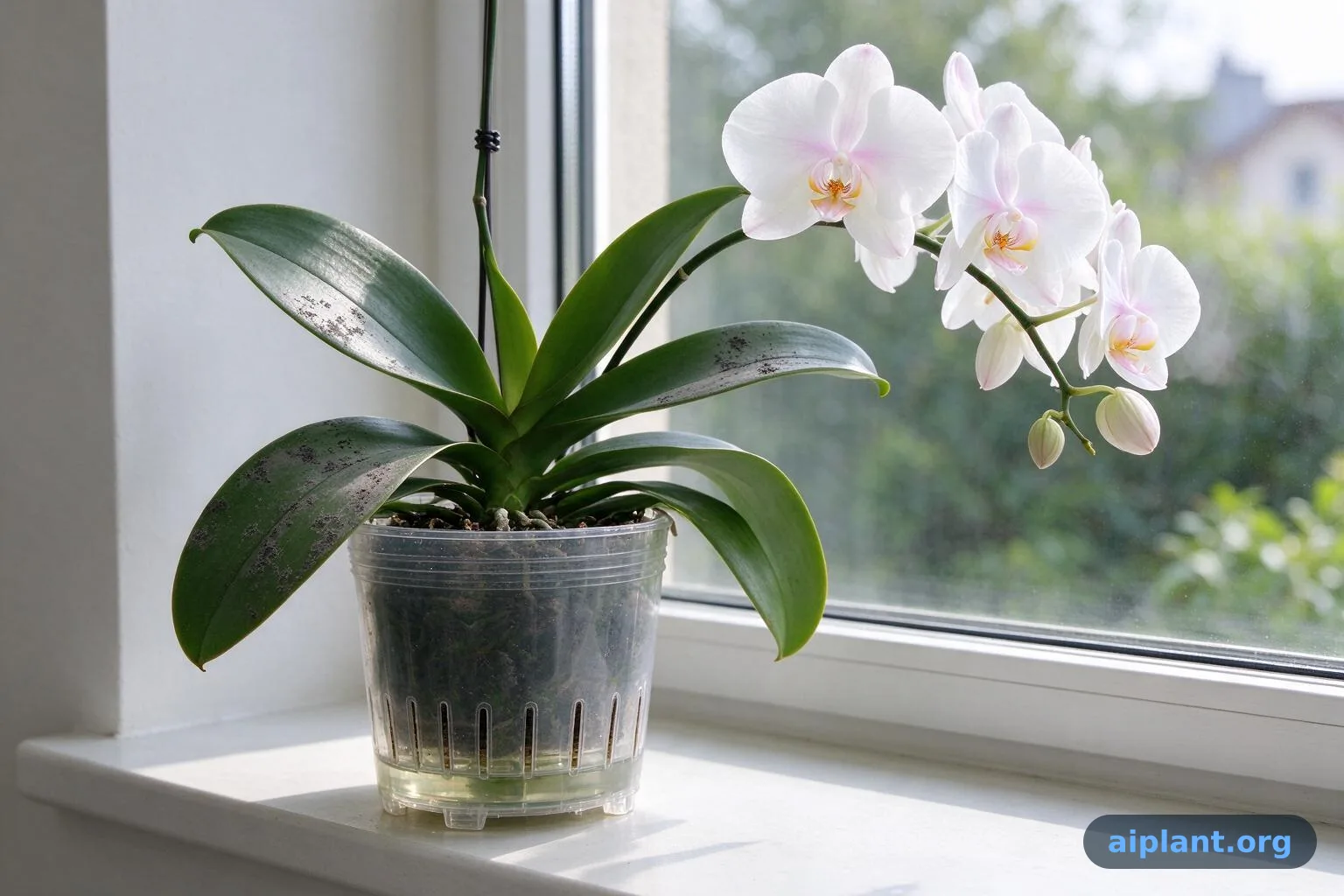
Sooty Black Mould on Phalaenopsis Orchid: The Short Answer
- Sooty black mould grows on honeydew from mealybugs, scale or aphids, not on the orchid tissue itself.
- Wipe the black film off with a damp cloth and treat the pests underneath with insecticidal soap or rubbing alcohol.
- Check roots and new growth weekly; pests hide in leaf joints and under the pot rim.
- Improve air movement and stop misting the leaves until the mould stops returning.
Phalaenopsis Orchid Symptom Check: Match What You See to the Cause
Use this table to move from the visible symptom to the most likely cause and the first action. Most sooty mould cases start with pests, but root problems, cold damage and bud drop can appear at the same time, so check the whole plant before treating.
Sticky Leaves and Fine White Insects in the Leaf Joints
The first sign is usually a shiny, sticky film on the upper leaf surface, with small white cottony clumps tucked where the leaf meets the stem. These are mealybugs, which feed on sap and excrete honeydew that sooty mould then colonises. Isolate the plant, dab each visible insect with a cotton bud dipped in 70% rubbing alcohol, and repeat every five to seven days for three weeks because eggs hatch between treatments. Check the underside of leaves and the pot rim, where mealybugs hide.
Hard Brown Bumps Along Stems and Leaf Midribs
Scale insects look like small, immobile brown or tan domes, 2–4 mm across, stuck along the flower spike and leaf veins. They do not move once settled, so they are easy to miss until honeydew and black mould appear. Scrape one with a fingernail: if it comes off as a waxy shell, it is scale. Remove them with a soft toothbrush and insecticidal soap, then wipe the honeydew away so ants stop farming the scale.
Black Sooty Film on Upper Leaf Surfaces
Sooty mould is a dark, powdery coating that wipes off with a damp cloth, revealing green tissue underneath. It grows only where honeydew has dripped, so its location tells you where the pests are sitting above. Clean the leaves gently with lukewarm water and a drop of mild soap, then dry them; do not scrape hard enough to damage the leaf surface. If the film returns within a week, pests are still active.
Yellowing Leaves and Soft, Mushy Roots at the Base
Leaves that turn yellow and soft from the bottom up, with brown mushy roots in the pot, point to overwatering and root rot rather than pests. Phalaenopsis Orchid roots need air; in a sealed pot or dense sphagnum they stay wet and die. Unpot the plant, cut away brown hollow roots with sterile scissors, and repot in fresh bark mix in a pot with drainage holes. Water only when the top 2 cm (0.8 in) of bark feels dry.
Buds That Drop Before Opening and No New Flowers
Bud drop is usually a reaction to a sudden change: cold draughts, ethylene from ripening fruit, or a move to a darker spot. Phalaenopsis Orchid needs a night temperature drop of about 5 °C (9 °F) for two to three weeks to initiate spikes. Keep the plant above 15 °C (59 °F), away from air-conditioning vents, and give bright indirect light; buds that yellow and fall within days of purchase often recover on the next spike.
Phalaenopsis Orchid Symptom, Likely Cause and First Action
Tiny White Bugs and Sticky Residue on Phalaenopsis Orchid Leaves
Tiny white bugs plus sticky residue almost always mean mealybugs or aphids feeding on the orchid's sap. The stickiness is honeydew, a sugary waste the insects excrete; it coats the leaf and feeds the sooty mould. Treat the insects and the mould clears on its own.
Mealybugs Are the Most Common Culprit
Mealybugs look like small white cotton tufts, 2–3 mm long, clustered in leaf axils, under the pot rim and along the flower spike. They feed by piercing tissue and sucking sap, so the plant weakens and new leaves emerge smaller. Isolate the orchid from other houseplants until no new white tufts appear for two weeks.
Aphids Cluster on Soft New Growth
Aphids are pear-shaped, 1–2 mm, and gather on new flower spikes and the softest leaves. They reproduce fast, so a small patch becomes a sticky mess within a week. Wash them off with a firm stream of lukewarm water, then spray the plant with insecticidal soap diluted to the label rate, covering leaf undersides. Repeat after seven days; do not spray in direct sun, because wet leaves can scorch.
Ants Farming the Pests
Ants do not damage the orchid directly, but they carry pests onto it and defend them for honeydew. If you see ants running up the pot, set ant bait stations near the base and wipe the sticky film off the leaves. Removing the honeydew removes the ants' food source, and the colony usually moves on within a week.
When Sticky Residue Appears Without Visible Insects
Honeydew can drip from a pest on a plant above the orchid, or from scale hidden under a leaf. Wipe a leaf with a white tissue: a clear sticky smear means honeydew, while a dry powdery mark is something else. Check the undersides of every leaf and the rim of the pot with a torch at night, when some pests are more active, before concluding the orchid is clean.
Small Brown Spots With a Powdery Film on Phalaenopsis Orchid Leaves
Small brown spots with a powdery film are usually a fungal leaf spot, not sooty mould, and they spread when water sits on the leaves. Sooty mould is black and wipes off; fungal spots are brown, sunken and do not wipe away. Treat them by drying the foliage and improving airflow.
Fungal Leaf Spot From Overhead Watering
Water droplets that sit on a leaf for more than a few hours let fungal spores germinate, producing brown spots 2–5 mm across with a powdery centre. Water the orchid at the pot rim in the morning so leaves dry by evening, and never mist the foliage in cool weather. Remove badly spotted leaves with sterile scissors, cutting 1 cm (0.4 in) into healthy tissue, and dispose of them away from other plants.
Bacterial Soft Rot Looks Similar but Spreads Fast
Bacterial rot starts as a water-soaked, translucent patch that turns brown and smells unpleasant within two days. It moves faster than fungal spot and can kill a leaf in a week. Cut the affected leaf back to clean green tissue, sterilise the scissors with alcohol between cuts, and stop all misting until the plant produces a new leaf without lesions. There is no safe home cure for advanced bacterial rot; if it reaches the crown, the plant is usually lost.
Powdery Film That Is Not Mould
A white or grey powdery deposit can also be dried fertiliser salts or hard-water residue, especially on leaves near the pot rim. Wipe it with a damp cloth: if it dissolves and leaves no dark stain, it is mineral residue, not disease. Flush the pot with room-temperature water once a month to stop salts building up, and use filtered water if your tap supply is hard.
Sooty Mould, Fungal Spot and Mineral Residue Compared
How to Get Rid of Mealybugs and Scale on a Phalaenopsis Orchid
Getting rid of mealybugs and scale means treating the whole plant, not just the visible insects, because eggs and crawlers hide in leaf joints and under the pot rim. A three-week programme of physical removal plus a soap spray clears most infestations.
- Isolate and inspect: Move the orchid at least 1 m (3 ft) from other plants and check every leaf underside, the flower spike and the pot rim with a torch. Mark where you find pests so you can recheck those spots after treatment.
- Remove visible insects: Target mealybugs individually with a swab of 70% isopropyl alcohol, and brush scale off with a soft toothbrush dipped in soapy water. Work from the top of the plant down so fallen insects do not recolonise clean leaves.
- Spray with insecticidal soap: Mix insecticidal soap at the label rate and spray the whole plant, covering leaf undersides and joints until it drips. Do this in the morning, out of direct sun, so the leaves dry before evening and do not burn.
- Repeat weekly for three weeks: Re-spray every five to seven days, because soap kills crawlers but not eggs; three rounds cover the hatching cycle. Stop when two consecutive checks find no new white tufts or brown domes.
- Clean the honeydew and mould: Wipe the leaves with a damp cloth and a drop of mild soap to remove sooty mould and sticky residue. Removing honeydew also removes the food that attracts ants and feeds the mould.
When to Replace the Plant
If scale covers more than half the leaves and the orchid has lost its roots to rot at the same time, the effort of rescue is unlikely to pay off. A plant with a firm green crown, at least two healthy aerial roots and one clean new leaf is still worth treating; one with a brown mushy crown is not.
Phalaenopsis Orchid Quick Care Facts
- Light
- Bright indirect; east window, no direct midday sun
- Water
- Soak bark when top 2 cm (0.8 in) feels dry
- Temperature
- 18–27 °C (64–81 °F); never below 15 °C (59 °F)
- Humidity
- 50–70%; use a tray of pebbles, not misting
- Soil
- Medium orchid bark, pot with drainage holes
- Fertilizer
- Half-strength orchid feed every two weeks in spring and summer
Phalaenopsis Orchid With Root Rot and Fungus Gnats: Can It Be Saved?
A Phalaenopsis Orchid with root rot and fungus gnats can often be saved if the crown is still firm and at least one or two healthy roots remain. Fungus gnats are a symptom of constantly wet bark, so fixing the roots fixes the gnats.
Recognising Root Rot and Gnat Larvae
Healthy orchid roots are firm, silvery-green when dry and green when wet. Rotting roots are brown, hollow and mushy, and the bark smells sour. Fungus gnat larvae are 3–5 mm white worms with black heads in the top 2 cm of wet bark; the adults are small black flies around the pot. Yellow sticky traps catch adults, but the larvae need the bark to dry out.
Repotting a Phalaenopsis Orchid With Mushy Roots and Brown Leaf Tips
- Unpot and rinse: Slide the orchid out of its pot and rinse the roots under lukewarm water to see which are firm and which are mushy. Brown leaf tips often mean salts or dry air, but mushy roots are the priority.
- Cut dead roots: Sterilise scissors with alcohol and cut brown hollow roots back to firm white tissue, removing about one-third of the root mass if needed. Leave silvery or green firm roots intact, because they still absorb water.
- Repot in fresh bark: Use medium-grade orchid bark and a pot only 2 cm (0.8 in) wider than the root ball, with drainage holes. Pack bark loosely so air reaches the roots; firm bark holds water and restarts the rot.
- Water sparingly for two weeks: Keep the pot on a dry saucer and empty it after every watering so roots never stand in water. Wait until the bark surface feels dry before watering again, since standing water suffocates roots and feeds rot.
- Break the gnat cycle: Let the top 2 cm of bark dry between waterings and place yellow sticky traps at pot level to catch adults. The larvae die as the surface dries, and the population collapses within two to three weeks.
Phalaenopsis Orchid Root and Bark Conditions
Phalaenopsis Orchid Not Flowering and Dropping Buds
A Phalaenopsis Orchid that will not flower is usually missing a cool night drop, enough light, or both, while bud drop is a reaction to a sudden change in temperature, light or air quality. Fix the environment and the next spike follows.
Why No New Flower Spike Forms
Phalaenopsis Orchid initiates spikes when night temperatures fall about 5 °C (9 °F) below day temperatures for two to three weeks. In a constantly warm room, the plant stays in leaf growth. Move it to a room at 16–18 °C (61–64 °F) at night in autumn, keep it in bright indirect light, and feed with a bloom-formula orchid fertiliser every two weeks until the spike appears.
Why Buds Yellow and Fall Before Opening
Buds drop when the plant experiences a sudden change: a cold draught from a window, ethylene from a bowl of ripening fruit nearby, or a move from a bright shop to a dark corner. Keep the plant above 15 °C (59 °F), away from draughts and fruit, and do not rotate the pot once buds are set. Buds that fall within a week of purchase often reflower on the same spike if the plant is left undisturbed.
When the Orchid Is Simply Resting
After flowering, a healthy Phalaenopsis Orchid may rest for several months before making a new spike. Cut the old spike 1 cm (0.4 in) above the second node if it is still green, or remove it at the base if brown, and keep watering and feeding. A plant with firm leaves and green roots that has not flowered for six months needs more light, not more fertiliser.
Phalaenopsis Orchid Yellow Soft Leaves at the Base and Cold Damage in Winter
Yellow, soft leaves at the base of a Phalaenopsis Orchid are usually the oldest leaves dying naturally, but if several turn soft and mushy at once, cold damage or rot is the cause. Cold damage shows as water-soaked patches that turn black within days.
Natural Leaf Aging Versus Disease
A single oldest leaf yellowing and drying from the tip is normal; the plant withdraws nutrients and drops it. Disease or cold damage affects several leaves at once, often with soft, translucent tissue and a bad smell. Leave a naturally aging leaf until it pulls away easily, then remove it; cut diseased leaves immediately with sterile scissors.
Treating Cold Damage After Winter
Phalaenopsis Orchid is tropical and suffers below 15 °C (59 °F); leaves touching a cold window can develop black patches overnight. Move the plant to a spot that stays 18–27 °C (64–81 °F), away from glass and draughts. Cut black mushy tissue back to firm green with alcohol-sterilised scissors, dust the cut with cinnamon powder, and withhold water for a week so the wound seals. Do not fertilise until a new leaf emerges.
Soft Base Rot From Water Sitting in the Crown
Water that pools in the crown where leaves meet the stem causes crown rot, which turns the centre brown and soft. Water at the pot rim, tilt the pot to drain, and never leave water in the crown overnight. If the crown is mushy, the plant cannot be saved; if only outer leaves are affected, remove them and keep the crown dry.
Slow Growth and Wrinkled Leathery Leaves on Phalaenopsis Orchid
Slow growth with wrinkled, leathery leaves means the orchid is not taking up water, usually because the roots are dry, damaged or the humidity is too low. The leaves lose firmness before the plant stops growing, so treat it as an early warning.
Dry Roots From Underwatering
If the bark feels dry 2 cm (0.8 in) down and the roots are silvery and papery, the plant is simply thirsty. Soak the pot in a bowl of room-temperature water for 10 minutes, then drain fully. Water again when the top 2 cm of bark feels dry, which in warm rooms is often every five to seven days.
Root Loss From Past Overwatering
Wrinkled leaves can also follow root rot: the roots died, so the plant cannot absorb water even though the bark is wet. Check by lifting the plant; if the bark is damp but the roots are brown and hollow, repot in fresh bark and water sparingly until new roots appear. New root tips are green and firm, and leaves firm up within a few weeks of active root growth.
Low Humidity and Hot Dry Air
Phalaenopsis Orchid grows best at 50–70% humidity; in heated winter rooms the air can drop below 30%, and leaves lose water faster than roots replace it. Stand the pot on a tray of wet pebbles so the base sits above the water, and group plants together to raise local humidity. Do not mist the leaves, because wet foliage invites fungal spots and sooty mould.
Sooty mould, pests and orchid rescue: what the article does not cover
How do I stop sooty mould coming back on my Phalaenopsis Orchid after I clean the leaves?
Sooty mould returns because honeydew is still being produced, so cleaning alone cannot stop it. After wiping the leaves, inspect weekly for pests in leaf joints, under the pot rim and along the spike; recheck any spot that blackens within a week. Increase air movement and stop misting foliage until two consecutive checks find no sticky film or new insects.
Can sooty mould spread from my Phalaenopsis Orchid to other houseplants nearby?
Yes, sooty mould can spread to nearby houseplants because the honeydew-feeding insects move between them. Mealybugs, scale and aphids crawl or are carried by ants, and honeydew drips onto leaves below. Isolate the orchid at least 1 m from other plants, check their leaf undersides and pot rims, and treat any infested plant before returning it to the group.
Should I cut off a Phalaenopsis Orchid leaf that is completely coated in black mould?
No, do not remove a leaf just because it is coated in black mould, since the film wipes off and green tissue usually remains beneath. Wipe it gently with lukewarm water and a drop of mild soap, then dry it. Cut the leaf only if the tissue underneath is brown, mushy or dead, using sterile scissors and cutting into healthy green tissue.
How do I treat sooty mould on a Phalaenopsis Orchid flower spike without damaging the buds?
Treat the spike by dabbing pests individually with a cotton bud dipped in 70% rubbing alcohol rather than spraying the whole spike, and wipe honeydew away with a damp cloth. Brush scale off with a soft toothbrush and soapy water. Avoid wetting buds, spray in the morning out of direct sun, and repeat checks every five to seven days.
Why does sooty mould keep returning on my Phalaenopsis Orchid even though I see no insects?
Sooty mould keeps returning because honeydew is still being produced by pests you have not yet found, not because the mould itself survives cleaning. Scale insects stay fixed as small brown domes along veins and the spike, so they look like part of the plant. Check leaf undersides, joints and the pot rim with a torch at night, and recheck any spot that blackens within a week.
Is it safe to use neem oil or fungicide on a Phalaenopsis Orchid with sooty mould?
Neem oil and fungicides are not the primary fix, because sooty mould feeds on honeydew rather than orchid tissue; removing the insects clears it. Insecticidal soap at the label rate, or rubbing alcohol dabbed on mealybugs, targets the pests directly. Spray in the morning out of direct sun so wet leaves dry before evening and do not scorch.
How do I clean sooty mould off Phalaenopsis Orchid roots and aerial roots?
Clean roots gently with lukewarm water and a soft cloth, wiping only the black film from firm roots; never scrape hard or scrub. Healthy roots are firm and silvery-green or green, while brown hollow mushy roots indicate rot and should be cut with sterile scissors. Repot in fresh bark and keep the crown dry so mould does not return.
Why did my Phalaenopsis Orchid get sooty mould after I moved it to a shadier room?
Moving to a shadier room does not cause sooty mould directly; the mould grows on honeydew from pests, and low light can weaken the orchid so infestations build unnoticed. Shade also slows leaf drying and reduces air movement. Give bright indirect light, improve airflow, and inspect for mealybugs, scale or aphids hiding in joints and under the pot rim.
Related articles
Orchid Root Rot, Yellow Leaves, No Blooms?
Reblooming Secrets Even Beginners Can Master
Tiny White Bugs and Sticky Leaves on African Violet?
Find the pest or disease behind the mess and fix it before rot spreads.
Why Is My Dill Plant Turning Yellow and Drooping?
Match the symptom, find the cause, and save the plant before it bolts.
Amaryllis Leaves Turning Yellow and Drooping: What to Fix First
Find the cause fast and keep the bulb alive for next year's blooms.