
Why Does Celery Have Sticky Leaves and a Powdery Film?
Find the cause in minutes, fix it, and keep the stalks safe to harvest.
Sticky celery leaves with a powdery film are a diagnosis, not a mystery: something is sucking sap and leaving sugar behind, or a fungus is growing on the leaf surface. The two most common answers are aphids with sooty mould, and powdery mildew, and they need different fixes. This first half of the article walks through the symptom table, explains how to confirm each cause with tests you can do at home, and gives the exact steps that stop the problem before it reaches the stalks you plan to eat.
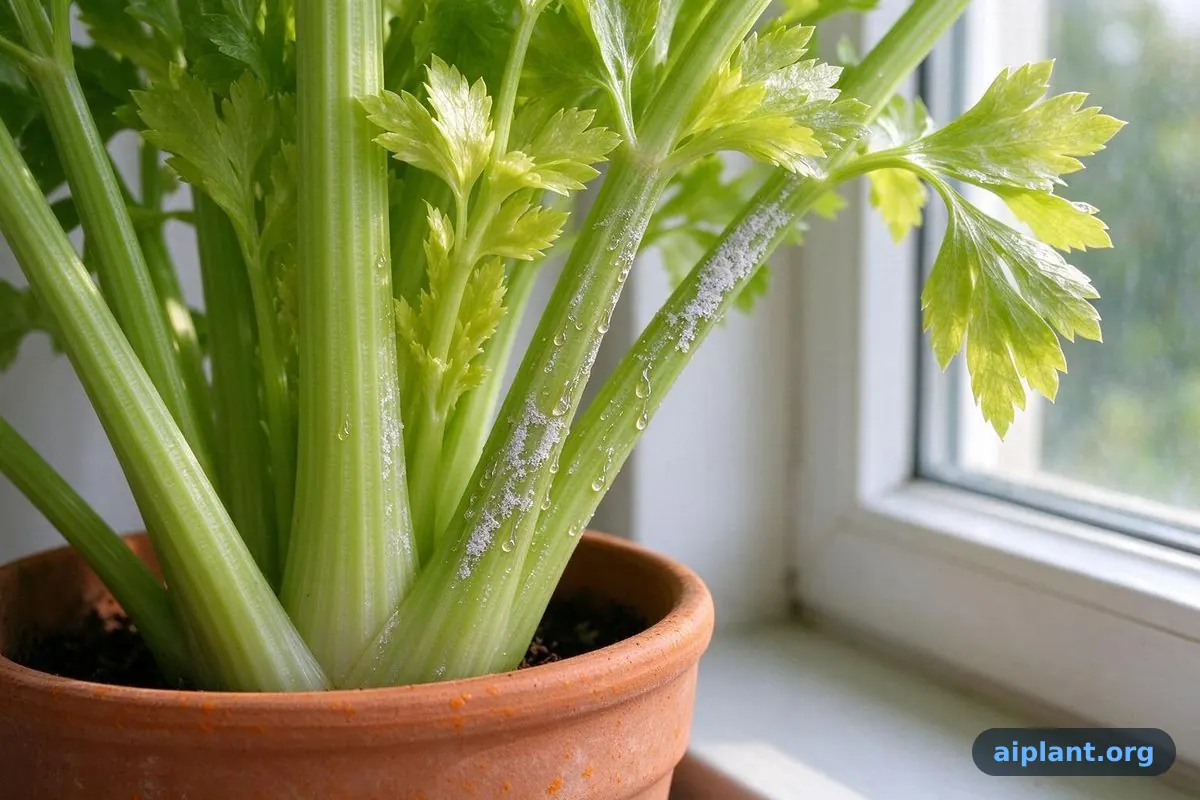
Celery Sticky Leaves and Powdery Film: The Short Answer
- Sticky leaves are usually honeydew from aphids, and the powdery film is sooty mould growing on that sugar or powdery mildew on the leaf surface.
- Turn a leaf over and look near the veins and growing tips: clusters of 1-3 mm soft-bodied insects confirm aphids.
- Wipe a white patch with a damp finger: sooty mould rubs off black, powdery mildew smears white and often puckers the leaf.
- Treat aphids first with a strong water spray and insecticidal soap, then improve airflow so mould cannot return.
- Leaves with light mould are still edible after washing and trimming; discard stalks that are soft, brown or foul-smelling.
Celery Symptom Check: What Sticky Leaves and a Powdery Film Mean
Celery (Apium graveolens) is a marsh plant with thin, waxy leaves and hollow stems, and that soft growth makes it a magnet for sap-sucking insects and surface fungi. Use the table as an index, then read the sub-heading for the symptom you actually see, because the fix for aphid honeydew is not the fix for powdery mildew.
Sticky Leaves With Tiny White or Green Insects Underneath
Sticky leaves are the signature of aphids, not of the plant itself. The insects feed on phloem sap and excrete honeydew, a clear sugary liquid that coats the upper leaf surface and makes it tacky to touch. Turn the leaf over and inspect the underside along the midrib and the youngest leaflets: aphids cluster there in groups of ten or more, are 1-3 mm long, and may be pale green, white or greyish. Winged adults appear when the colony is crowded. Ants farming the honeydew are a second confirmation.
- Isolate and spray off the colony: move the pot or block away from other celery, then spray the undersides with water at household pressure for two minutes to knock off most insects, repeating every two to three days until no new clusters appear.
- Follow with insecticidal soap: apply a ready-to-use soap spray to the leaf undersides in the evening, when temperatures are below 27 °C (80 °F), coating until it drips, and repeat every five to seven days for three rounds so newly hatched aphids are caught.
- Clear the honeydew and mould: once the insects are gone, wipe the sticky film with a damp cloth and a drop of mild soap, because honeydew left in place keeps feeding sooty mould even after the aphids die.
A Grey or Black Powdery Film on the Upper Leaf Surface
Sooty mould is a black, charcoal-like coating that grows on honeydew rather than on the plant, so it always follows an insect infestation. It looks like soot dusted over the leaf, peels off in flakes when dry, and rubs away to reveal green tissue underneath. The mould itself does not penetrate the leaf, but a heavy coat blocks light and reduces photosynthesis, which shows as pale, slow growth. Control the sap-suckers and the mould disappears; washing the leaves speeds the recovery.
White Powdery Patches That Smear When Touched
Powdery mildew is a true fungus, not honeydew residue. It starts as small white spots on the older outer leaves, spreads into a floury coating, and often puckers or curls the leaf edge. Unlike sooty mould it does not rub off cleanly; a damp finger smears it white. It thrives when days are warm and nights are cool with poor airflow, typically 15-27 °C (60-80 °F) with high humidity and crowded plants. Remove affected leaves, thin the planting so air moves, water at soil level in the morning, and apply a sulfur-based or potassium bicarbonate fungicide labelled for edible crops, following the label interval before harvest.
Brown or Black Spots on Leaves and Stalks
Dark lesions are usually a bacterial or fungal leaf spot, most often Septoria apiicola, which starts as small yellow-brown spots on older leaves and develops into brown-black speckling with tiny fruiting bodies. It spreads by splashing water and infected seed. Cut off affected leaves at the base, stop overhead watering, and stake or space plants so foliage dries within an hour of watering. Badly spotted stalks are still edible after trimming the lesions away, but discard any stalk that is soft or smells sour.
Tall, Thin, Bare Stalks With No Side Shoots
Celery that stretches upward with long bare internodes and few leaflets is reacting to low light and warm nights, not to disease. Indoors, a windowsill that receives less than six hours of direct sun produces exactly this look, because the plant elongates to find light. The fix is light and pinching: move it to the brightest spot available or add a grow light for 14-16 hours a day, keep nights below 21 °C (70 °F), and pinch the outer stems at harvest so the centre keeps producing new growth.
Hollow or Split Stems Down the Middle
Hollow, cracked stalks are a growth-rate problem, not an infection. Rapid growth after a dry spell, or a sudden cold snap below 10 °C (50 °F), makes the inner tissue expand faster than the outer skin, and the stem splits. Boron deficiency produces the same hollow centre on sandy soils. Water steadily so the soil stays evenly moist, avoid high-nitrogen feeds that push soft growth, and harvest before stems over-mature; split stems are still edible once the cracked portion is trimmed.
Are Affected Celery Leaves Still Safe to Eat?
Yes, in most cases. Leaves carrying aphids, honeydew, sooty mould or light powdery mildew are edible after thorough washing and trimming. Rinse under running water, rub the leaf surfaces, and cut away any portion that is blackened, mushy or foul-smelling. Discard leaves with dense mould or soft rot, and never eat celery that smells sour, because that indicates bacterial soft rot rather than a surface problem.
Celery Sticky Leaf Symptom, Likely Cause, and First Action
Tiny White Bugs on Celery and the Powdery Film They Leave Behind
The tiny white bugs on celery are almost always aphids, and the powdery film is the sooty mould that grows on the honeydew they excrete. Confirming the insect is the first step, because a spray that kills aphids does nothing for powdery mildew and vice versa.
How to Confirm Aphids Rather Than Whitefly
Aphids sit still and cluster; whitefly adults fly up in a white cloud when the leaf is disturbed, and their nymphs look like flat scales. Tap a celery leaf over a white sheet of paper: if small green or white insects fall and crawl slowly, aphids are present. Look also for cast skins, which appear as tiny white flakes stuck to the honeydew.
Why Celery Attracts Them
Celery has soft, thin leaves with high nitrogen content, and aphids reproduce fastest on that flush of tender growth. A single aphid can produce a new generation in seven to ten days at 20-25 °C (68-77 °F), so a small cluster becomes a coating within two weeks. Indoor celery grown under lights, or outdoor rows fed heavily with nitrogen, is the most common setting.
A Three-Step Aphid Clean-Up
- Wash the colony off: hold each stem under a running tap or use a hose with a spray nozzle, directing water at the leaf undersides for a full minute per plant, which removes most aphids and their honeydew in one pass.
- Apply insecticidal soap or neem: spray in the evening so the leaves do not burn, covering undersides and growing tips, and repeat every five to seven days for three applications so aphids hatching from surviving eggs are killed.
- Set a yellow sticky trap nearby: hang one trap per pot or per metre of row to catch winged adults and to monitor whether the population is falling; replace the trap when it is half covered.
Dealing With the Powdery Film After the Insects Are Gone
Sooty mould cannot survive without honeydew, so it fades once the aphids are controlled. Wipe the upper surfaces with a damp cloth and a drop of mild soap, then rinse with clean water. Do not use a harsh scrub, because celery leaf tissue tears easily and torn leaves invite bacterial rot. New growth should emerge clean within two to three weeks.
When the Plant Is Past Saving
If more than half the leaves are coated in mould, the stems are soft at the base, or the plant smells sour, discard it rather than treating it. Soft rot bacteria move faster than any home remedy, and the plant will not produce a usable harvest. A plant with sticky leaves but firm, green stalks is worth saving.
Celery Pest Look-Alikes and How to Tell Them Apart
What Celery Needs So Sticky Leaves and Mould Do Not Come Back
Prevention for celery is mostly airflow, even moisture and steady cool temperatures, because the pests and fungi that cause sticky leaves all exploit still air and soft, fast growth.
Light and Airflow Keep the Leaf Surface Dry
Celery grows best with six or more hours of direct sun and constant air movement. Outdoors, space plants 20-25 cm (8-10 in) apart in rows 45-60 cm (18-24 in) apart so leaves dry quickly after rain. Indoors, run a small fan on low for a few hours a day and keep the plant away from a closed window corner where humidity collects.
Water at the Base, Not Over the Leaves
Wet foliage is the main driver of powdery mildew and leaf spot. Water in the morning at soil level, aiming for about 2.5 cm (1 in) per week including rain, and check with a finger pushed 3 cm (1 in) into the soil: if it feels dry at that depth, water; if it is damp, wait a day. Consistent moisture also prevents the split and hollow stems that come from wet-dry swings.
Feed for Firm Growth, Not Soft Growth
Too much nitrogen produces the tender, sappy leaves aphids prefer. Use a balanced feed at half strength every three to four weeks, and keep the soil pH between 6.0 and 7.0, which is the range where celery takes up nutrients efficiently. Pale older leaves with green veins point to magnesium shortage; yellowing between veins on new growth points to iron, and both are corrected by the balanced feed rather than by extra nitrogen.
Temperature Limits for Celery
Celery grows best between 15 and 21 °C (60-70 °F). It tolerates light frost but suffers below 10 °C (50 °F), when growth stalls and stems can split; above 24 °C (75 °F) with warm nights it turns stringy and bolts. Move pots indoors before the first forecast below 5 °C (41 °F), and shade outdoor rows with 30-40% shade cloth during heat spells above 30 °C (86 °F).
Harvest and Storage That Keep Stalks Crisp
Cut outer stalks at soil level when they are 20-25 cm (8-10 in) long, about 85-120 days from transplanting, and leave the centre rosette to keep growing. Store unwashed stalks wrapped in a damp paper towel inside a perforated bag in the refrigerator crisper, where they keep for two to three weeks; wash only just before use. For longer storage, chop and freeze the stalks, which hold their flavour for up to six months.
Celery Quick Care Facts
Celery Care at a Glance
- Part Used
- Leaf stalks and leaves
- When to Harvest
- Outer stalks at 20-25 cm (8-10 in)
- How to Dry
- Leaves air-dried in shade, 1-2 weeks
- Storage Life
- Wrapped in fridge 2-3 weeks
- Light
- Six or more hours direct sun
- Water
- Evenly moist, 2.5 cm (1 in) weekly
Why Celery Turns Bitter and Stringy Instead of Tender
Bitterness and stringiness come from stress and over-maturity, not from the variety alone: celery that is left too long, grown too hot or watered unevenly develops tough vascular bundles and a sharp, bitter taste. The same plant harvested young and cool is mild and crisp, so the fix is timing and steady conditions rather than a different seed packet.
Heat and drought are the two fastest ways to make celery stringy: above 24 °C (75 °F) with dry soil, the plant thickens its cell walls and pulls water from the stalks, leaving fibrous strands. Keep the bed mulched and water at soil level so the root zone stays evenly damp, and shade rows with 30-40% cloth during hot spells, because a cool root run is what keeps the leaf stalks tender.
Over-mature stalks turn bitter from the outside in: the outer stems are the oldest and accumulate the most fibre, so cut them first when they reach 20-25 cm (8-10 in) and leave the pale heart to size up. A stalk that bends rather than snaps, or shows white stringy threads when broken, is past its best and should go to stock rather than the salad plate.
A late nitrogen feed softens the taste but not the fibre: celery that has been pushed with high-nitrogen fertiliser grows fast and watery, then turns bitter when the feed runs out. Use a balanced feed at half strength every three to four weeks and stop feeding about three weeks before harvest, so the stalks firm up rather than flushing soft growth.
Blanching is the traditional way to mellow a strong-tasting crop: tying the outer stems together or wrapping them with cardboard for two to three weeks before harvest excludes light from the inner stalks, which reduces bitterness and keeps them pale and tender. Check the bundle weekly and loosen it if the leaves look damp, because trapped moisture invites rot.
Growing Celery Indoors Without Sparse, Leggy Stems
Indoor celery goes leggy when it gets less than six hours of direct sun: a windowsill that faces away from the sun, or a room kept warm at night, makes the plant stretch for light and drop its lower leaflets. The fix is a bright, cool position: a south- or west-facing window, or a grow light run for 14-16 hours a day, with nights kept below 21 °C (70 °F).
Pinching the outer stems keeps the centre busy: celery grows from a central rosette, and if the outer stalks are never cut the plant puts its energy into height rather than side shoots. Harvest the outside stems first, cutting at soil level, and the heart will keep pushing new leaflets from the middle instead of running up a bare stem.
A pot that is too small stalls growth and forces early bolting: celery needs a container at least 25 cm (10 in) deep and wide, because its roots run shallow but spread. Repot into fresh compost when roots show at the drainage holes, and water so the mix stays evenly moist but never waterlogged, since soggy soil rots the crown and dry soil crisps the leaf edges.
Cool nights and steady moisture are what indoor celery misses most: central heating dries the air and warms the nights, and both push the plant into thin, fast growth. Group pots on a pebble tray, run a small fan on low for a few hours a day for airflow, and keep the room between 15 and 21 °C (60-70 °F) where you can.
Propagating Celery From the Base and From Seed
Celery regrows readily from the cut base, which is the fastest way to a second harvest: cut a supermarket bunch about 5 cm (2 in) above the base, stand the base in a shallow dish of water, and keep it on a bright sill. Roots and new green shoots appear in one to two weeks; pot it into moist compost when the shoots are 5 cm (2 in) tall, and keep the soil damp while it establishes.
Seed is slower and needs a cool start: Expect germination in two to three weeks; thin seedlings to 20-25 cm (8-10 in) apart once they have four true leaves, because crowded seedlings never size up into thick stalks.
Transplant carefully, because celery resents root disturbance: lift each seedling with a fork and move it with its root ball intact, watering it in at the new spot. Plants that are checked at transplanting often bolt or stay thin, so handle the roots gently and keep the new position cool and evenly moist for the first week.
A cut base gives you a plant, but not always a thick one: regrown bases tend to produce many thin stems rather than a fat bunch, so treat them as a leaf crop and harvest often. For thick stalks, seed-grown plants or bought transplants spaced correctly give the better result.
Kitchen and Traditional Uses of Celery Leaves and Seed
Every part of celery is usable, and the leaves carry the strongest flavour: the stalks are eaten raw or cooked, the leaves are chopped into soups, stocks and salads, and the seed is used whole or ground as a spice. Leaves picked fresh from the outside of the rosette are the most aromatic, so add them at the end of cooking to keep their scent.
Celery seed is commonly brewed as a tea and used as a kitchen spice: the small brown seeds are crushed and steeped in hot water for a mild, savoury drink, and they are traditionally used in pickling blends and celery salt. Celery has also been traditionally used in folk preparations, but no health claim should be read into that.
Drying preserves the leaves for winter cooking: spread clean leaves in a single layer in a shaded, airy room for one to two weeks until they crumble, or dry them in a dehydrator on the lowest setting. Store the crumbled leaves in an airtight jar away from light, where they keep their flavour for about a year.
The seed and the leaf are used differently in cooking: seed is strong and should be added early so it can mellow, while fresh leaf is delicate and goes in at the end. A pinch of ground seed in a stew replaces a whole stick of celery when none is to hand.
Who Should Be Careful With Celery
People with a celery allergy should avoid it entirely, including the seed and cooked stalks: celery is one of the more common food allergens, and reactions can range from itching in the mouth to more serious symptoms. Anyone who has reacted to celery before should not eat the stalks, leaves, seed or celery salt, and should check labels for celery as a listed ingredient.
Pregnant and breastfeeding people should ask a doctor or pharmacist before using celery seed preparations: culinary amounts of the stalk in food are ordinary, but concentrated seed extracts and strong seed teas are a different matter. Children should also not be given concentrated celery seed products without medical advice, and anyone taking medication should check with a doctor or pharmacist first, because plant preparations can interact with prescribed drugs.
People with kidney problems should be cautious with large amounts of celery: the plant is high in oxalates and in potassium, so anyone advised to limit either should keep portions modest and ask their doctor or pharmacist about suitable amounts. This is a reason to treat celery as a food rather than a daily concentrated tonic.
Wash and trim before eating, whatever the source: rinse stalks and leaves under running water, rub the surfaces, and cut away any bruised, slimy or mouldy parts. Celery that smells sour or feels soft at the base should be discarded rather than trimmed and eaten.
Celery pests, diseases and harvest troubleshooting
How do I grow celery from seed indoors, and when should I start it before the last frost?
Start celery seed indoors about 10 to 12 weeks before the last frost, since germination takes two to three weeks and seedlings are slow to size up. Sow thinly on moist seed compost, press the seed in without covering deeply because light helps germination, and keep the surface damp at 15-21 °C (60-70 °F). Thin to one seedling per cell once four true leaves appear.
Can I grow celery in a pot on a balcony, and what size container and watering routine does it need?
Yes, celery grows in a pot if it is at least 25 cm (10 in) deep and wide, because roots run shallow but spread. Use fresh compost, keep it evenly moist but never waterlogged, and aim for about 2.5 cm (1 in) weekly, checking with a finger pushed 3 cm into the mix. Give six or more hours of direct sun and good airflow.
How do I protect celery from frost and extend the harvest into autumn or winter?
Celery tolerates light frost but stalls and can split below 10 °C (50 °F), so move pots indoors before a forecast below 5 °C (41 °F). Outdoors, cover rows with fleece or cloches at night, mulch to keep roots steady, and cut outer stalks rather than lifting the plant. Cool, steady conditions keep stalks tender and slow bolting.
What should I do about celery bolting to seed before I can harvest the stalks?
Bolting is driven by heat, warm nights and stress, so shade plants with 30-40% cloth above 30 °C (86 °F), water evenly at soil level, and avoid high-nitrogen feeds that push soft growth. Once a flower stem rises, cut it out and harvest remaining stalks promptly, because bolted celery turns stringy and bitter.
How do I blanch celery stalks to make them pale and mild without rotting the heart?
Blanching works by excluding light from inner stalks for two to three weeks before harvest, using tied outer stems or a cardboard wrap, which reduces bitterness and keeps them pale. Check the bundle weekly and loosen it if leaves look damp, since trapped moisture invites rot. Harvest the pale heart promptly once blanched.
Which companion plants help keep aphids and mildew off celery, and which should I avoid planting nearby?
Strong airflow and even moisture do more than any single neighbour. Aromatic herbs such as dill and parsley and flowers like marigolds are traditionally used nearby to distract aphids, while avoiding fennel, which competes and may inhibit growth. Space plants 20-25 cm apart so leaves dry quickly after rain.
How do I fertilize celery through the season, and when should I stop feeding before harvest?
Use a balanced feed at half strength every three to four weeks, since too much nitrogen produces the sappy leaves aphids prefer. Keep soil pH between 6.0 and 7.0 for efficient uptake. Stop feeding about three weeks before harvest so stalks firm up rather than flushing soft growth.
Why are the leaf edges of my celery turning brown and crispy, and how do I fix it?
Crispy brown leaf edges usually mean uneven water or a dry root zone, sometimes worsened by salty tap water or soggy soil that rots roots. Water at soil level in the morning, aiming for about 2.5 cm weekly including rain, and test 3 cm down before watering again. Mulch to steady moisture and keep the crown above wet soil.
How do I save celery seed from my own plants for next year's crop?
Celery seed is collected from plants left to flower and set seed, which happens after the stalks have bolted. The article only notes the small brown seeds are used as spice, so let umbels turn brown and dry on the plant, then cut them into a paper bag to finish drying in a shaded, airy room. Rub the heads to release seed and store in an airtight jar away from light.
Can I regrow supermarket celery in soil, and how long until I can harvest from it?
Yes, a supermarket bunch can be regrown: cut about 5 cm (2 in) above the base, stand the base in a shallow dish of water on a bright sill, and roots with new green shoots appear in one to two weeks. Pot it into moist compost when shoots reach 5 cm (2 in) tall. Expect many thin stems rather than a fat bunch, so harvest it as a leaf crop.
Related articles
Tiny White Bugs and Sticky Leaves on African Violet?
Find the pest or disease behind the mess and fix it before rot spreads.
Why Does My Turmeric Have Sticky Leaves and Tiny Bugs?
Identify the pest, clear the sticky honeydew, and still lift a healthy crop.
Amaryllis Leaves Turning Yellow and Drooping: What to Fix First
Find the cause fast and keep the bulb alive for next year's blooms.
Why Are My Apple Tree Leaves Turning Yellow?
Find the cause in minutes and keep the fruit coming.